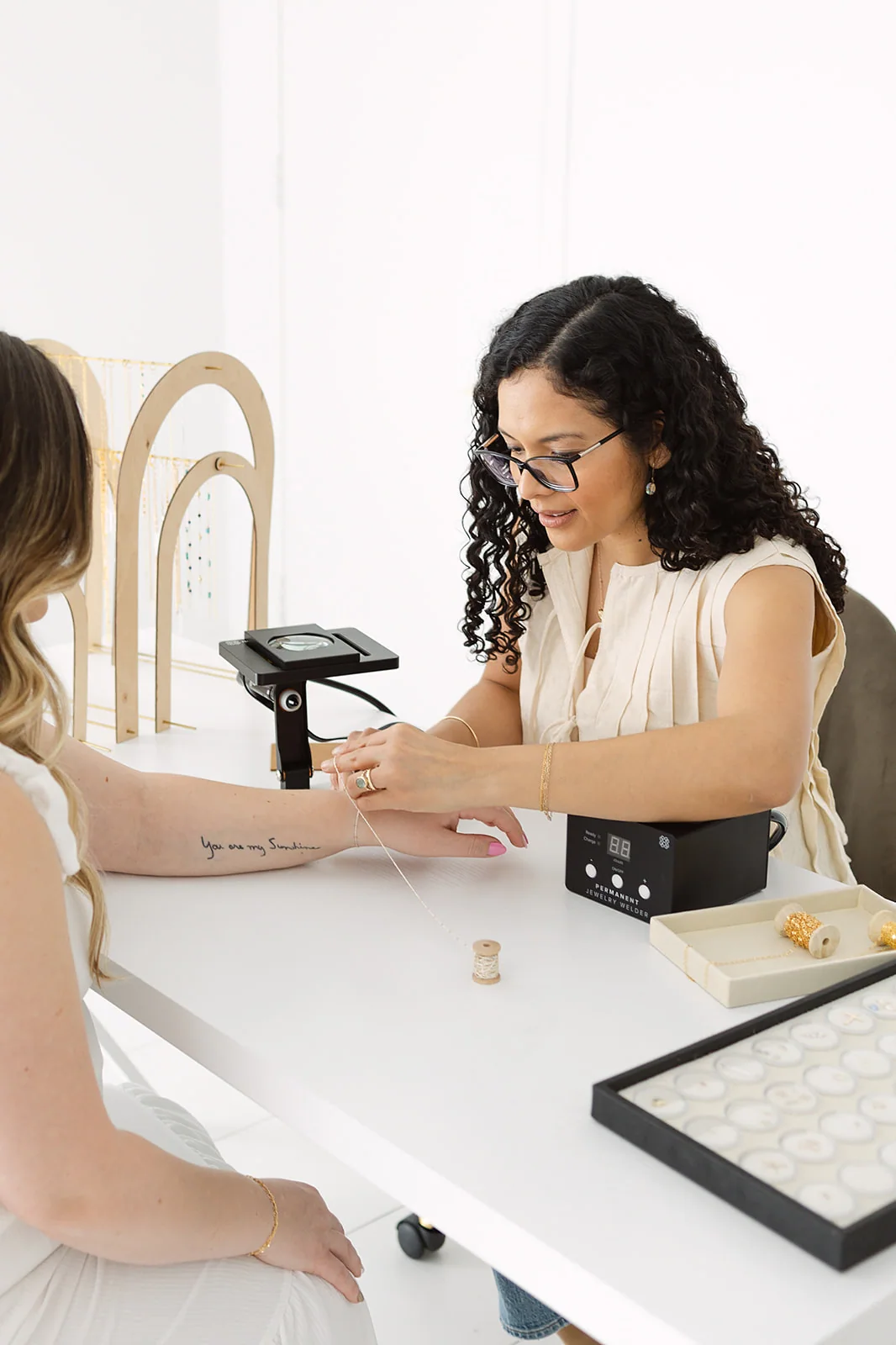
If you've watched someone weld a tiny bracelet in a few seconds and charge $50 or more, I know what you're thinking: “Wait, is this a great side hustle?”
It can be. But I want to give you a more useful answer than one of those videos promising thousands of dollars every weekend, because I've actually run the business behind the clips.
I'm the founder of Bezalel & Co. I started making jewelry in 2021, spent years running pop-ups and appointments, and eventually taught other people about permanent jewelry. I've had exciting sales days and exhausting ones. Here are the parts I'd consider before investing.
Why it can be a good side hustle
Customers like the experience. Permanent jewelry can be a friendship activity, a birthday treat, a party add-on, or simply a piece someone wants to wear every day. It's personal and visual, which makes it easier to explain and demonstrate online.
You don't necessarily need a storefront. Mobile appointments, vendor markets, private parties, and corporate events can all be options depending on permissions and demand. That makes the business flexible for someone who doesn't want commercial rent.
Inventory can be relatively compact. Compared with businesses that sell hundreds of finished product variations, a modest chain selection and findings can serve multiple customers. You still need to budget appropriately for equipment and safety.
You can start part-time. You don't need to commit to a five-day schedule before you know what your local audience wants.
Why I wouldn't call it easy money
For every beautiful TikTok about a perfectly welded bracelet, there's work you don't see: practicing, cleaning equipment, researching chain quality, responding to messages, traveling to an event, paying vendor fees, maintaining insurance, and deciding how to handle repairs.
And the biggest challenge for many beginners isn't the welding—it's finding customers consistently.
A sold-out market makes a great story. The quieter markets are also part of small business life. Even a high-traffic event can be a mismatch if shoppers weren't looking to spend money on jewelry.
The revenue math people leave out
Suppose you sell 20 bracelets at $50 each. That's $1,000 in gross sales. It's not $1,000 profit.
If, for illustration, each bracelet had $14.25 in variable costs, that would leave $715 before the booth fee, insurance, travel, equipment, taxes, and paying yourself. After a hypothetical $150 booth fee, you'd have $565 left before those remaining expenses.
That's still potentially worthwhile! But I would rather you make your decisions using the real math than chase an unrealistic screenshot.
Markets, appointments, or parties: which is best?
I loved events, but each channel has tradeoffs.
| Model | Advantage | Challenge |
|---|---|---|
| Pop-up markets | Lots of potential customers in one place | Fees, weather, travel, unpredictable buyer fit |
| Appointments | More predictable setup and personalized service | You must generate individual bookings |
| Private parties | Built-in group and social experience | Scheduling, minimums, host coordination |
| Corporate events | Possible group volume | Longer sales cycle and planning |
I would test one channel, record your numbers, and build from there. There is no prize for trying every possible business model your first month.
What I would do differently today
I'd keep my initial chain selection small, invest in supported welding equipment, practice extensively, research markets by visiting them, and film more of the educational process. I'd also be disciplined about tracking how much time I spent on the business—not just my sales totals.
One of the best things I learned was how useful education content can be. People have so many questions about permanent jewelry, from safety to metal quality to whether the bracelet can be removed. Answering those questions builds trust before someone ever books.
What about turning it into a full-time job?
You need repeatable demand, adequate profit, an emergency cushion, and a plan for seasonality. A few successful weekends don't automatically mean your business can replace a salary. Before scaling, calculate profit after every expense and assess whether the work fits the life you want.
For me, permanent jewelry was part of a larger creative business. It taught me a lot about selling, teaching, product sourcing, and connecting with customers. I'm grateful for that—and I also know it wasn't passive income.
So, would I recommend it?
Yes, to someone who enjoys hands-on work, is willing to learn a technical skill safely, and likes serving people. Not to someone hoping a welder alone will create instant income.
If you're seriously researching it, start with how to launch a permanent jewelry business and my honest startup budget.
Ready to price out equipment? Browse my permanent jewelry shopping lists and download my starter checklist. These are the categories and supplier options I would research first, based on equipment I've used and lessons I've learned.
Keep learning
Good technique and thoughtful business decisions begin with clear information. Browse the free supplier library, practical worksheets, and interactive tools.