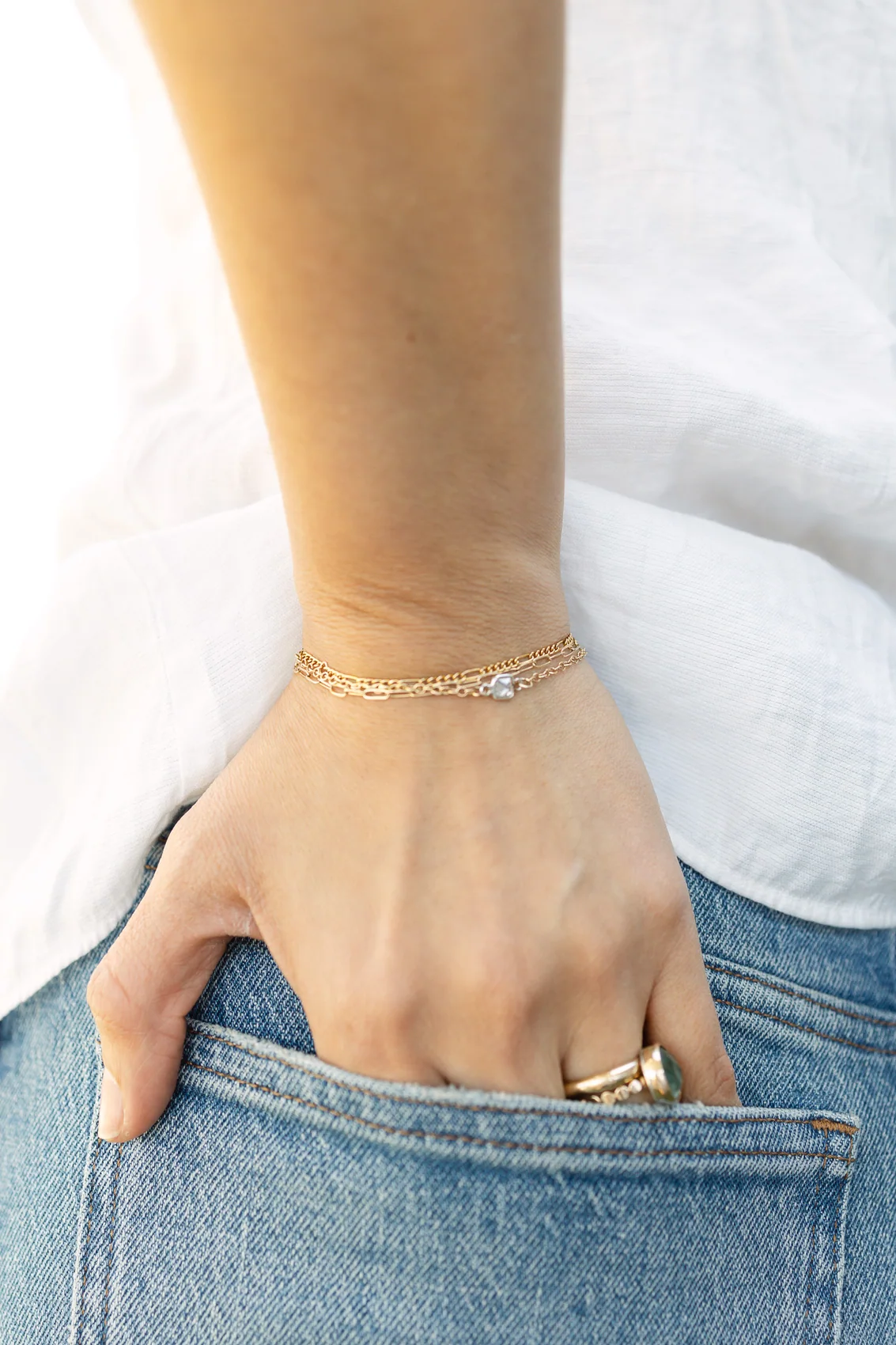
I have a permanent jewelry pricing opinion that might annoy a few people: charging less isn't automatically a good beginner strategy. If you build your entire business around being the cheapest artist at the market, it's very difficult to pay yourself fairly—or replace your equipment when something breaks.
I've priced permanent jewelry, sourced wholesale chains, worked markets, and done the math behind the pretty bracelets. Here's a pricing approach that actually accounts for the business.
First, calculate the real cost of the piece
Start with the chain cost per inch. If a five-foot spool costs $90, that's 60 inches of chain, or $1.50 per inch before shipping and waste. A seven-inch bracelet uses $10.50 in chain in this example.
Now add the jump ring, any connector or charm, practice and cutting waste, packaging, and a realistic allocation for equipment consumables. Then account for the fees attached to the sale itself. These are sample amounts, not a claim about current chain prices.
A $50 bracelet example
Let's use a hypothetical seven-inch bracelet:
| Cost category | Example amount |
|---|---|
| Chain (7 in × $1.50) | $10.50 |
| Jump ring and small consumables | $1.00 |
| Packaging / material waste allowance | $1.00 |
| Payment processing allowance | $1.75 |
| Subtotal of these variable costs | $14.25 |
| Sale price | $50.00 |
| Remaining before overhead, labor, and taxes | $35.75 |
That $35.75 is not your profit. You still need to cover the event fee, equipment, insurance, travel, marketing, bookkeeping, time spent making the piece, and taxes. This is precisely why I cringe when someone prices based only on the chain.
Divide event fees by realistic sales, not dream sales
Imagine a $150 market booth fee. If you sell 10 bracelets, the booth costs $15 per bracelet. If you sell 30, it's $5 each. And that's before your travel and setup time.
You can't choose the attendance, but you can research events carefully. Over years of vending, I learned that “huge crowd” and “people willing to buy my product” are not interchangeable. I would rather pay for the right market than the biggest one.
Private parties and appointments can have different economics. They may involve fewer travel costs per transaction or minimum bookings, but you still need to account for setup and customer service.
Start with a formula, then check the market
A useful planning method is:
Selling price = variable material and transaction costs + allocated overhead + paid labor + desired profit.
You can work backward from customer prices to see whether the model works. But don't blindly double chain cost and call that a pricing strategy. If you buy chain efficiently, your equipment costs don't magically disappear.
My old Bezalel & Co. pricing used different starting points for different items—bracelets, anklets, hand chains, necklaces, and rings—because the experience and amount of chain aren't identical. Your prices should reflect your actual costs and local customer demand, not a copy of mine.
Bulk buying: when it really saves money
I love a good wholesale deal, but here's the trick: calculate cost per foot and total cash required.
One past chain tier I compared listed $99 for five feet and $445 for 25 feet. That means $19.80 per foot in the smaller tier versus $17.80 per foot in bulk. Across 25 feet, the difference is $50 in listed merchandise price.
That is a genuine unit-cost advantage—but only if you use the chain. If you're new and don't know your bestsellers, five feet of a few great chains can be smarter than 25 feet of one unproven design. Prices and availability change, so always check current tiers.
Do not underprice to look accessible
You can offer different price points without trying to make everything the lowest price in town. An entry-level chain and a premium design can coexist. The more important thing is that both are profitable, properly described, and consistent with the experience you promise.
Customers aren't paying only for metal. They're paying for a service that involves your time, your craftsmanship, your tools, and your judgment. Make sure your pricing acknowledges that.
What I track after a market
I want to know gross sales, products sold, material consumed, vendor fee, travel cost, card fees, time spent, repairs, and whether I would book that same event again. That's the data that should drive your next pricing or inventory decision.
If you haven't already, read my permanent jewelry startup cost article and my business launch guide.
Looking for wholesale suppliers? I've organized my actual supplier shortlist in my chain and tools resource guide. Compare current quantity discounts before you commit to a big reel.
Keep learning
Good technique and thoughtful business decisions begin with clear information. Browse the free supplier library, practical worksheets, and interactive tools.